

*How to Reduce Time-to-Productivity for New Hires Without Overloading Them

A new hire does not become productive because they have received enough information. They become productive when they know what to do with that information.
That is the mistake many onboarding programmes make. They try to reduce time-to-productivity by adding more: more modules, more induction sessions, more documents, more videos, more process walkthroughs, and more checklists. The intention is right, but the result is often the opposite.
The new hire is not accelerated; they are overwhelmed. They finish onboarding with a full head, a long list of bookmarked links, and one quiet fear: “I still don’t know what I’m supposed to do first.” Reducing time-to-productivity is not about giving new hires more content faster. It is about helping them become ready for useful work sooner.

The Quick Answer: How Do You Reduce Time-to-Productivity?
To reduce time-to-productivity for new hires, organisations should design onboarding around role readiness instead of content completion. This means sequencing information, explaining key concepts, clarifying expectations, using realistic scenarios, involving managers at the right moments, and measuring whether employees can apply learning in their actual role.
In simple terms:
Do not ask: “Have they completed onboarding?” * Ask: “Are they ready for the next meaningful task?”
Why Onboarding Design Dictates Organizational Success
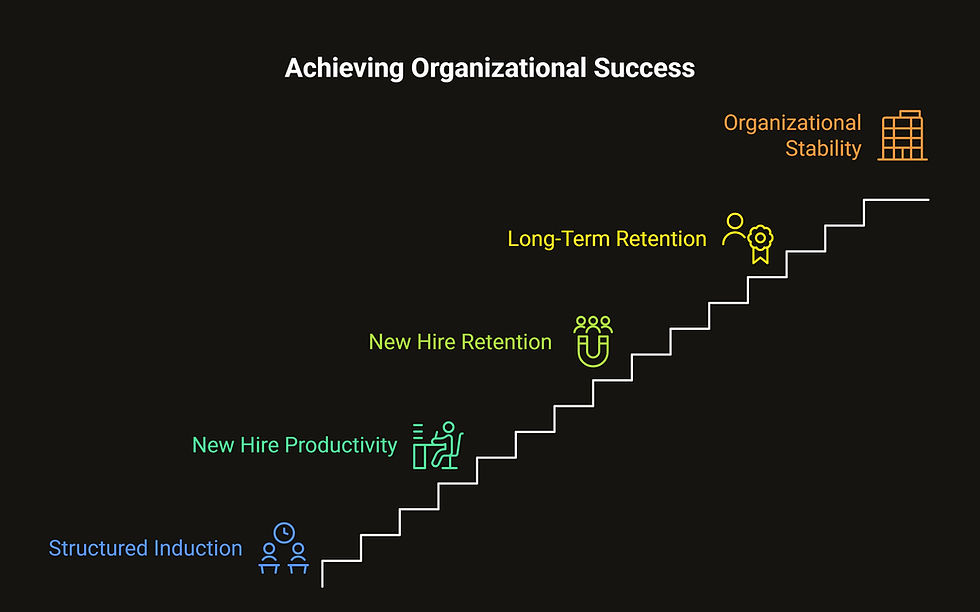
When done right, a structured approach doesn't just clear up day-to-day confusion—it fundamentally transforms your baseline business metrics. According to data from the QuoDeck ICE Cube Framework, organizations that establish well-structured induction programs experience massive organizational boosts:
54% greater new hire productivity.
50% greater new hire retention rate.
69% greater long-term employee retention.
The effectiveness of how smoothly you ramp up your new talent acts as a primary engine for long-term organizational stability and success.
What is Time-to-Productivity?
Time-to-productivity is the time it takes for a new employee to start contributing meaningfully in their role. It does not mean the employee has mastered everything, nor does it mean they require zero support. Instead, it means they have reached a point where they can perform useful work with the right level of independence, confidence, and manager oversight.
For a sales role: This may mean holding a first customer conversation with confidence.
For an operations role: It may mean completing a core workflow without repeated correction.
For a customer service role: It may mean resolving standard queries while knowing exactly when to escalate.
For a manager: It may mean conducting the first meaningful team check-in or performance conversation.
Every role has a different productivity point. The problem is that many onboarding programmes never define it clearly. They focus entirely on what the employee must complete, but ignore what the employee must be ready to do.
The Overload Trap in Onboarding
Most onboarding teams are trying to be exceptionally helpful. They want the new hire to have everything they could possibly need, so they dump it all into the first week:
Each individual item may be useful. But together, they create a severe bottleneck. The new hire receives information faster than they can mentally organize or apply it. When information is not organized around immediate action, it becomes noise.
This is why many new hires can complete onboarding perfectly on a dashboard and still feel wildly underprepared. They were given access to knowledge, but they were not given a clear path to performance.

More Onboarding Content Does Not Automatically Create Faster Productivity
There is a common, flawed assumption in onboarding design: If new hires need to become productive faster, we should give them more information earlier.
Productivity rarely improves through volume alone. A new hire does not need all information immediately; they need the right information at the right moment, connected directly to the task they are expected to perform next.
For example, a new relationship manager does not need every granular product detail on Day 1. They first need to understand:
Who the customer is
What the role is expected to achieve
What a good conversation looks like
What questions to ask and what signals to notice
When to involve a senior colleague and what core mistakes to avoid
The deeper product knowledge can come later. The first need is not completeness; it is usable clarity.
The Real Blocker: Unclear Expectations
When new hires are slow to become productive, the issue is not always capability. Often, it is expectation ambiguity. They are fundamentally unsure about:
What matters most in the first week.
Which tasks they should attempt independently vs. which tasks they should observe first.
What quality standard is expected and what mistakes are acceptable while learning.
When they should raise their hand for help, and how their manager will judge readiness.
This creates hesitation, and hesitation slows productivity down to a crawl. The employee waits, the manager repeats, and the team steps in to compensate. Meanwhile, the HR onboarding dashboard says "100% complete," but the actual productivity ramp is deeply delayed. A strong onboarding programme removes this ambiguity early by telling the new hire not just what to learn, but what they are expected to do with that learning.
The Productivity Ramp: From Information to Readiness (The ICE Cube Approach)
A better way to design onboarding is to structure your program around three distinct layers: Information, Concepts, and Expectations. This forms the foundational core of the ICE Cube Framework, a methodology built to help HR and L&D teams plan out precisely what to cover, how to deliver it, and who to involve.
By segmenting content across these three layers, you ensure onboarding does not only tell people what they need to know, but clarifies why it matters and what they must visibly demonstrate:

1. Information: What does the new hire need to know?
Information is the data-based content that forms the foundation of your workspace context. This includes company overviews, policies, systems, tools, team structures, and employee IDs.
However, information must be sequenced. Not everything belongs on Day 1. Ask yourself: “When will the employee actually need this information?”
If they need it before joining, send it via a pre-boarding app.
If they need it for Day 1 confidence, include it early.
If they need it for Week 3 application, do not overload them with it in the first week.
If they need it only when a specific situation arises, lock it away as a searchable job aid.
2. Concepts: What does the new hire need to understand?
Concepts provide the meaning behind the information, offering the broader job and domain context necessary for true skill development. Examples include deeper domain knowledge, end-to-end processes, and role-specific workflows.
For example, it is not enough to show a new hire an escalation flow chart. They need to understand why escalation exists, what risks it prevents, which signals indicate urgency, and which issues they can resolve independently. Concepts build professional judgment. Without them, employees memorize steps but fail to apply them when a real-world scenario doesn't match the training manual.
3. Expectations: What does the new hire need to demonstrate?
Expectations are where onboarding ties directly into behavioral norms, industry regulations, and performance tracking. This layer outlines exactly what the role expects them to demonstrate over time: What should they be able to do independently by Week 1? What can they handle by Day 15? What does "good" look like, and what constitutes risky behavior?
This is often the missing layer in modern programs.
Many programs tell new hires what the company wants them to know, but fail to mention what they are expected to demonstrate. Expectations create active movement.
A Practical Model: The 7-15-30 Productivity Ramp
Instead of designing onboarding as a monolithic, continuous lecture, break it into a progressive ramp. At each stage, map out the scope across the entire spectrum—stretching across the Industry, Company, and Employee levels—to ensure total role alignment.
Stage | Focus | Productivity Question |
Day 0–7 | Orientation and Confidence | Can the employee understand the role, team tools, immediate priorities, and basic industry/workspace context? |
Day 8–15 | Guided Application | Can the employee perform basic job functions and processes with structured support and real-time feedback? |
Day 16–30 | Early Independence | Can the employee handle defined work situations and customer workflows with reduced handholding? |
This structure prevents Day 1 overload while ensuring onboarding never becomes too passive. The new hire is consistently moving toward visible, bite-sized readiness milestones.
What to Remove from Early Onboarding
One of the fastest ways to eliminate cognitive overload is to stop treating all corporate content as urgent. Early onboarding should never be a dumping ground for every department’s slide decks. Run your content through this filter before allowing it into the first week:
Is this required for immediate day-one confidence?
Is this required to complete their very first meaningful task?
Is this required to avoid catastrophic, expensive mistakes?
Is this better delivered later when they have more context?
Is this structural content, or is it actually an expectation of behavior?
Is this something a manager should contextualize on the floor rather than a trainer in a classroom?
A lot of onboarding content is not wrong; it is just presented way too early. And when useful content appears before it's needed, it becomes entirely forgettable.
What to Add Instead: Application Moments
If the goal is accelerated time-to-productivity, onboarding must swap passive consumption for active practice. This means reducing reliance on long lectures and replacing them with varied learning styles—utilizing a strategic mix of Instructor-led sessions, targeted Coaching, and self-paced E-learning.

The purpose is not to test people harshly. The purpose is to help them rehearse reality before reality becomes expensive. A new hire who has actively practiced a scenario via e-learning or a coaching simulator is significantly more likely to act with confidence when facing an actual client or operational bottleneck.
The Manager’s Role in Reducing Time-to-Productivity
Managers should never have to exhaustively compensate for a weak corporate onboarding system. Instead, they should be treated as a key pillar within the readiness system.
The manager is uniquely positioned to evaluate role clarity, observe early error patterns, and judge actual skill readiness. Rather than a vague mandate to "please support the new hire," give managers highly structured, practical checkpoints:
End of Week 1 Checkpoint: Confirm absolute role clarity, workspace access, and immediate priorities.
End of Week 2 Checkpoint: Review the new hire's first guided task, scenario performance, or caselet analysis.
End of Week 3 Checkpoint: Explicitly identify confidence gaps, track repeated clarifications, and align coaching needs.
End of Week 4 Checkpoint: Officially decide what defined workflows the employee can now handle independently.
How to Measure Whether Time-to-Productivity is Improving
You cannot improve time-to-productivity if you only measure course completion percentages. You must track metrics that connect onboarding directly to actual business performance:
Time to First Meaningful Task: How many days it takes for the employee to complete their first unit of useful work.
Scenario Performance: Their scoring on simulated, contextual role challenges before going live.
Manager Confidence Rating: A structured score indicating whether the manager trusts them with defined work independently.
First-Task Quality: The error rate or quality standard of their earliest standalone outputs.
Number of Repeated Clarifications: Tracking where the employee is repeatedly getting stuck, showing where onboarding needs immediate reinforcement.
Time to Reduced Handholding: The rate at which dependency on supervisors or buddies decreases over the first 30 days.
Five Ways to Reduce Time-to-Productivity Without Overload
Define the First Productivity Milestone: Do not start with a list of content. Start with the work. Ask: “What is the first meaningful thing this employee should do?” Design backwards from there.
Sequence Information by Usefulness: Transition from “everything they might ever need” to “what they need for the next step.” This ensures information is absorbed in context.
Teach Concepts, Not Just Steps: When employees understand why a policy or process exists, they can adapt and make smart decisions when real-world situations vary.
Make Expectations Visibly Clear: Tell employees exactly what success looks like at Day 7, 15, and 30. Do not make them guess your standards.
Use Scenarios to Build Confidence: Use active simulators, coaching, and caselets to let new hires practice judgment safely before facing real-world consequences.
The Mistake to Avoid: Confusing Speed with Rushing
Reducing time-to-productivity does not mean pushing employees through your training pipeline faster. That almost always backfires. Speed without readiness creates immense stress, drives up error rates, and compromises quality.
The goal is not rushed onboarding; it is sharper onboarding. Sharper onboarding removes unnecessary fluff, sequences what truly matters, prioritizes hands-on practice, and systematically builds manager confidence. Exceptional onboarding programs don't simply compress time—they drastically reduce wasted time.
The New Onboarding Question
The Old Question: “How quickly can we get people through our onboarding program?”
The Better Question: “How quickly can we help people become ready for useful work?”
Shifting to this question forces HR and L&D teams to ruthlessly prioritize content, obligates business lines to define clear benchmarks, gives managers a practical checklist, and maps out a transparent path for the new hire. It transforms onboarding from a passive corporate event into a highly dynamic, performance-linked productivity ramp. And that is exactly what your workforce needs: not more content, but a clear, uncluttered route from learning to doing.
FAQ: Reducing Time-to-Productivity in Onboarding
What does time-to-productivity mean in onboarding?
Time-to-productivity is the time it takes for a new hire to start contributing meaningfully in their role. It measures how quickly an employee moves from passively learning about their job to actively performing useful work with the appropriate level of organizational support.
How can onboarding reduce time-to-productivity?
Onboarding reduces this timeline by sequencing information based on when it's needed, clarifying exact role expectations, focusing heavily on core underlying concepts, leveraging realistic practice scenarios, and integrating managers into structured readiness check-ins.
Why do new hires take too long to become productive?ICE-Cube
The most common causes are onboarding program overload, ambiguous performance expectations, learning content that is completely disconnected from daily operational realities, and a lack of structured feedback loops between the new hire and the manager.
What should HR and L&D measure during onboarding?
Instead of tracking login completion metrics alone, teams should measure time to first meaningful task, scenario application scores, manager confidence ratings, early task error rates, and the speed at which manual handholding is reduced.
How can companies avoid overwhelming new hires?
Companies can mitigate cognitive overload by prioritizing week-one essential knowledge, delaying advanced or non-urgent information to continuous learning phases, transforming dense modules into easily searchable job aids, and utilizing staged learning ramps.
Build Onboarding as a Productivity Ramp
If your new hires are checking every box on your onboarding checklist but still taking months to become operationally useful, the root issue isn't employee effort—it's structural design.
The ICE Cube Framework balances Information, Concepts, and Expectations across a clear matrix to turn information delivery into true business readiness. Stop building onboarding as a text-heavy data dump, and start building it as a structured path directly to performance.
Want to audit your current onboarding program and see where cognitive overload is slowing down your teams? [Download the ICE Cube Framework here] to map out a sharper, highly effective productivity ramp for your modern workforce.


Comments