

The Readiness Shift: Moving Onboarding from Flat Data Consumption to Operational Execution

Most onboarding teams try to solve slow ramp-up by adding more modules, more induction sessions, more documents. They treat onboarding as a content delivery process. But the new hire is not accelerated; they are overwhelmed by cognitive noise.
In many organizations, onboarding becomes a bloated content container. Compliance ticks the Information layer, but programs fail to validate deeper Concepts and Expectations.The GetSetQuo Approach systematically replaces this content dump with an engineered readiness journey.
Traditional onboarding programs are often designed as a content delivery process, not as a readiness journey. A content delivery process asks: “What content do we need to give the learner?” A readiness journey, powered by the GetSetQuo Approach, asks: “What does this learner need to become ready for this role, and how do we guide, motivate, assess, and support them until they get there?”

1. The Real Problem With Onboarding
The real problem with onboarding is rarely the absence of content; it is the absence of journey design. When everything is presented as important, learners struggle to identify what is truly critical. Through the lens of the GetSetQuo Approach, this systemic design failure manifests in several distinct traps:
The Overload Trap: When useful content appears too early, it becomes forgettable noise because it is not organized around immediate action. Under the GetSetQuo Approach , this happens when a program over-indexes on the Information layer before anchoring the deeper Concepts and Expectations.
The "Average Learner" Fiction: Standardized journeys treat all new joiners in a role as though they are identical. In reality, the GetSetQuo WHO pillar reveals that the average learner is a design fiction—some are highly experienced, some are completely new to the industry, some are digitally native, and others require repeated reinforcement.
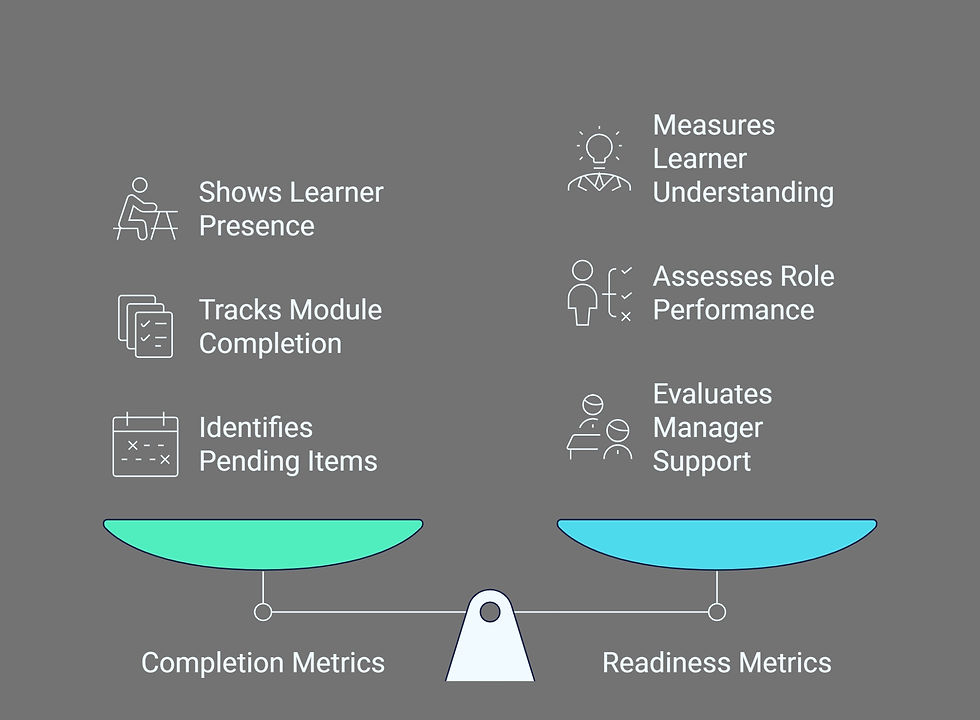
Completion as a False Metric: Most dashboards track participation signals (e.g., who completed a module or passed a basic recall quiz) rather than readiness signals. In a GetSetQuo context, a learner can turn a dashboard green by simply consuming data, yet still be highly confused on day one of actual production.
The Invisible Cost of Manager Dependency: When onboarding is weak, managers become the fallback system. Instead of spending time on high-value coaching, judgment, and feedback, managers are forced to repeat basic process explanations and correct early mistakes, absorbing the operational cost of unachieved readiness.
Key Insight: Productive new hires don't just consume data; they know how to execute it. The GetSetQuo Approach recognizes that completion is merely a participation signal—it tracks information delivery, not operational readiness.
2.Introducing the GetSetQuo Approach Framework & the ICE-Cube Content Architecture
To re-engineer onboarding from an act of faith into an engineered performance ramp, organizations can deploy the GetSetQuo Approach. This structured methodology maps the onboarding experience across the GetSetQuo layers to unlock measurable role readiness:
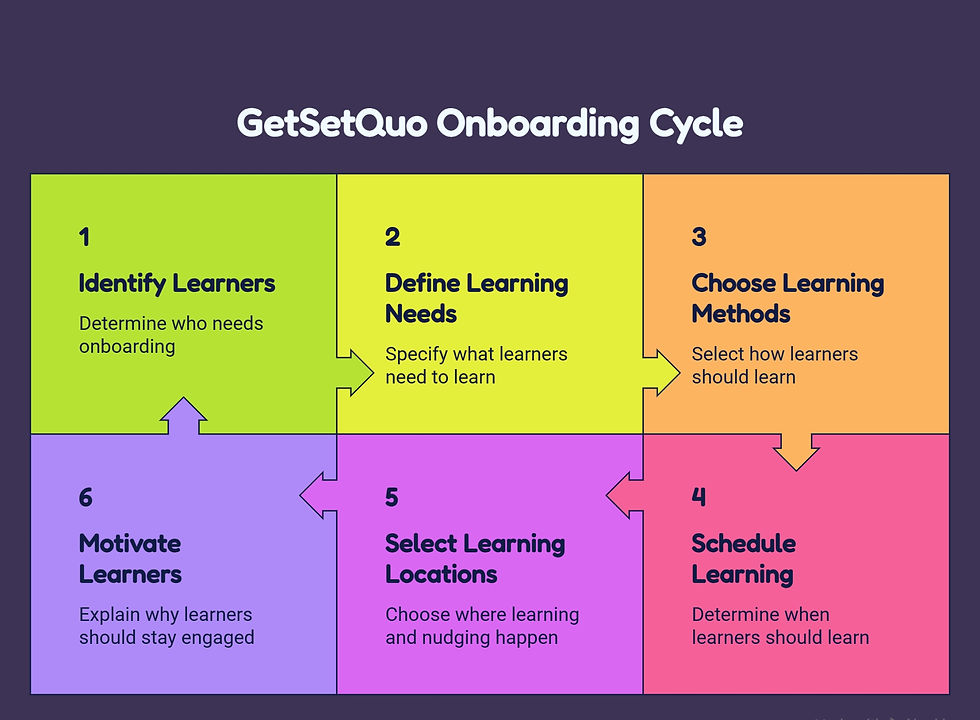
WHO is the learner? (Archetyping & Personalization)
Onboarding must design intelligent variations based on who is joining. A Fast Starter (experienced, low risk) requires a fast-tracked path focusing on advanced scenarios and early readiness checks. Conversely, an Overwhelmed Newcomer (new to the role, lower confidence) requires smaller content chunks, frequent encouragement nudges, and deep reinforcement.
WHAT do they need to learn? (The ICE-Cube Content Architecture)
Instead of operating from an open content repository, content must be structured around three functional layers designed backward from the first meaningful milestone:
I - Information: What the new hire needs to know (policies, systems, tools). This must be rigorously classified into Must-Know (critical for immediate safety, compliance, or core tasks), Should-Know (improves performance but can wait), and Optional (searchable job aids or reference archives).
C - Concepts: The "why" behind the "what." Teaching the foundational philosophy helps employees exercise sound corporate judgment when real-world situations vary from static training examples.
E - Expectations: What the new hire must demonstrate sequentially. This turns onboarding from a content delivery event into a visible performance ramp.
HOW do they learn? (Format Fit & Applied Learning)
If the role requires action, onboarding cannot remain passive. Formats must match the instructional objective: short videos/explainers work well for introducing concepts, while branching simulations, role-play prompts, and simulated customer conversations are necessary to build decision-making capabilities and real-world confidence.
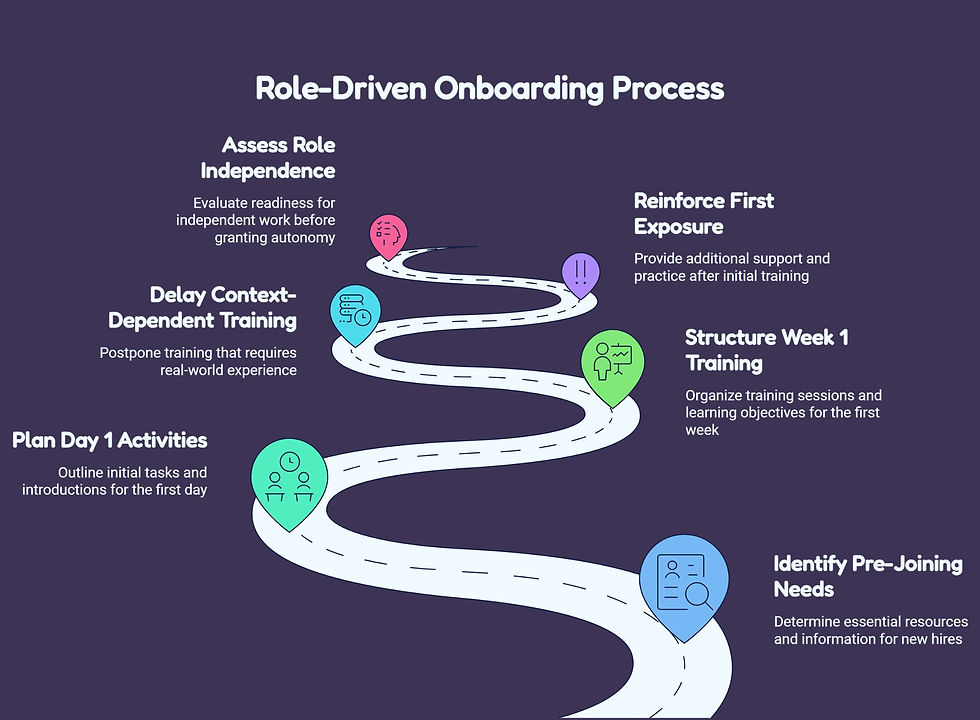
3. Designing a Practical Timeline: The Staged Drip Journey
One of the fastest ways to eliminate cognitive overload is to stop treating all content as urgent. Time is a core instructional design variable, not an administrative detail. By utilizing a drip journey format, information is sequenced by context and immediate usefulness.
A blueprint for a role-readiness sequence includes:
Stage 1: Day 0–7 (Orientation and Confidence)
Productivity Focus: Can the employee understand their immediate role boundaries, tools, and priority expectations?
Content/Experience: Pre-boarding mindset setup, core compliance ground rules, basic system access, and reducing day-one anxiety.
Manager Checkpoint: Confirm absolute role clarity and set the immediate workflow priorities.
Stage 2: Day 8–15 (Guided Application)
Productivity Focus: Can the employee perform baseline tasks safely with built-in feedback loops?
Content/Experience: Step-by-step visual flows, applied process checklists, peer shadowing, and low-stakes simulated practice scenarios.
Manager Checkpoint: Review the new hire's execution of their first guided task or simulation.
Stage 3: Day 16–30 (Early Independence)
Productivity Focus: Can the employee successfully handle defined, standard work situations with minimal handholding?
Content/Experience: Advanced objection handling, corner-case process flows, deep-dive product features, and mandatory readiness assessments.
Manager Checkpoint: Evaluate remaining confidence gaps and finalize the formal readiness sign-off to execute independent work.
4. Where and Why: Ecosystem Integration & Nudge Mechanics
To ensure onboarding sticks, learning cannot be isolated inside a standalone platform that employees must remember to log into. It must behave like an ecosystem integrated directly into the channels where the employee’s workday actually happens—such as email, mobile apps, or internal messaging channels.
Borrowing proven mechanisms from marketing automation, a readiness-led onboarding journey utilizes behavior-based triggers to maintain momentum:
Streak Nudges: Encourages a daily rhythm of learning to build durable habits.
Recovery Nudges: Autonomously re-engages a new hire who has dropped off the journey before reaching a milestone.
The main point in onboarding is the
Manager Prompts: Automatically alerts a manager when a new joiner displays a comprehension gap or a dip in engagement, prompting a timely human intervention.
5. Transitioning to a Readiness Metric System
You cannot optimize time-to-productivity if your only point of evaluation is a completion percentage. True maturity requires a comprehensive ladder of measurement:
By shifting the primary operational metric from "Did they finish onboarding?" to "Are they ready for the next meaningful task?", organizations gain radical visibility into talent performance.
The handover in onboarding is not completed when an invitation link hits a new hire’s inbox; it is achieved only when that new hire confidently drives performance on the business floor.
Is Your Onboarding Program Truly Creating Readiness?
Evaluate your current strategy against the 5W1H pillars using the GetSetQuo Onboarding Readiness Diagnostic. If your current program acts as a content dump rather than a performance ramp, it may be time to shift your design toward measurable role readiness.
► Download the GetSetQuo Approach to run a comprehensive structural analysis on your corporate training paths today.
Conclusion
In the past, finance leaders were valued for the accuracy of their analysis. In the future, they will be valued for the operational quality of their decisions because in an AI-driven world: Insights are abundant, time is limited, and judgment is everything. In the GetSetQuo Approach, optimization does not come from a flat "content dump" of information alone. Decisions are instead improved by experiential context—and that experience, at scale, can now be systematically engineered into a structured readiness journey.


Comments