

How to Design an Employee Onboarding Programme That Actually Works

Your onboarding programme probably covers a lot. Company overview. Policies. Systems. Products. Processes. Compliance modules. Culture videos. Leadership messages. And at the end of it, your completion dashboard is green. But your managers are still saying the same thing they said before you redesigned the programme
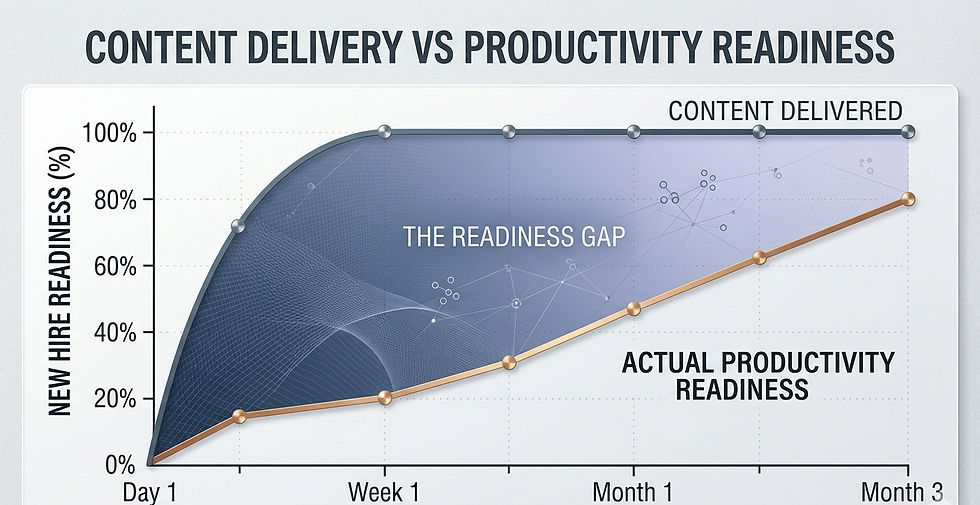
Most onboarding is designed to deliver content. But content delivery and productivity are not the same thing. And the difference between them is the reason 88% of employees describe their onboarding experience as poor — not because HR teams are not working hard enough, but because the design question they are answering is the wrong one.

The old question: “What do we need to cover?”
The better question: “What does this person need to be able to DO — and how do we design the journey that gets them there?” This guide walks through a six-question framework — the 5W1H approach — that transforms onboarding from a content calendar into a productivity journey.
| Key Insight : To design an employee onboarding programme that works, answer six design questions before building any content: WHO is the learner, WHAT do they need to learn, HOW should they learn it, WHEN in the journey should each piece of learning happen, WHERE will it be delivered, and WHY will they stay engaged

88% of employees describe their onboarding experience as poor.
— Gallup, 2025
Why most onboarding programmes fail — even the well-designed ones
When organisations design onboarding, they typically start with a list. Which topics need to be covered? Which departments need a session? Which compliance items are mandatory?
The result is a programme that is comprehensive on paper and incomplete in practice. It delivers content. But it does not deliver capability. The new hire attends every session, completes every module, passes every quiz. Then sits at their desk waiting to be told what to do first. That is not a new hire problem. That is a design problem.
Only 12% of employees say their organisation does onboarding well.
— Gallup, 2025
The issue is not programme length, digital vs in-person, or content quality. The issue is that most onboarding is designed around the organisation's convenience — what departments want to say, what compliance requires, what the LMS can track. Effective onboarding is designed around the learner's journey. And that starts with six better questions.
The six questions every onboarding programme must answer
The 5W1H framework is built around six design questions that should be answered before a single piece of content is created. These are not administrative questions. They are design decisions. Get them right and your onboarding becomes a journey with momentum, milestones, and a clear destination.

Question 1 — WHO: Design for the learner, not just the role
The first question most onboarding programmes never ask. Not 'What does a Sales Manager need to know?' — but 'Who is this specific person, and what does their starting point look like?
A first-jobber joining your sales team and a 12-year industry veteran switching from a competitor are both Sales Managers. They should not be on the same onboarding journey.
When onboarding treats every new hire the same, it wastes time for some and leaves others behind.
The four learner profiles to design for
Fast Starter — experienced, confident, ready to act. Needs context and role clarity, not basics.
Overwhelmed Newcomer — first role or first industry. Needs sequencing, reassurance, and visible milestones.
Experienced Switcher — knows the function, new to your company. Needs the 'how we do it here' layer.
Compliance-Risk Learner — high-stakes role with regulatory exposure. Needs structured expectations and clear consequences.
Personalised onboarding journeys improve new hire confidence scores by over 30% compared to standardised programmes.
— SHRM, 2025


Question 2 — WHAT: Build content that creates capability, not just knowledge
Most onboarding programmes struggle with WHAT to cover because they try to cover everything. The ICE-Cube framework separates onboarding content into three layers:
Information — what the new hire needs to know. Facts, policies, products, processes, systems. The foundation layer.
Concepts — what the new hire needs to understand. The logic behind the information. Why the process exists, why the product solves a specific problem.
Expectations — what the new hire needs to demonstrate. What good performance looks like. What decisions they should make independently by Day 30.
Most programmes are heavy on Information and light on Concepts and Expectations. That is why employees can complete every module and still not know what good looks like in their role.

Question 3 — HOW: Match the format to the learning need
Not what you teach. How you teach it. A compliance requirement is not served well by a 45-minute classroom session. A difficult client conversation is not served well by a tick-box e-learning quiz.
Three delivery formats and when to use each
E-learning — self-paced knowledge, compliance content, product information, practice simulations. Scalable and measurable.
Instructor-led — discussion, scenario exploration, attitude orientation. Best for topics where context and debate matter.
Coaching — on-the-job judgment, real situation practice, confidence building. Most expensive. Also most effective for role readiness.
Wrong match | Right match |
Escalation policy in a 1-hour ILT session | Escalation scenario in e-learning with decision branches |
Product knowledge in a 3-day classroom | Product e-learning + coached customer conversation practice |
Culture and values in a compliance module | Values discussion in instructor-led orientation |
Sales conversation skills via recorded video | Coached role-play with manager feedback in Week 2 |
Question 4 — WHEN: Sequence the journey, do not dump it on Day 1
This is the most commonly broken rule in onboarding design. Day 1 should not contain everything. Yet for most organisations, it does. Each item may be useful. Together, they are overwhelming. Information delivered faster than it can be organised becomes noise.
On average it takes 8 months for a new employee to reach full productivity. Effective sequencing in onboarding can reduce this by 2 to 3 months.
— Gitnux, 2026
A practical journey sequence
Pre-boarding — context before Day 1. Industry overview, company story, role expectations.
Day 1 — belonging, not bombardment. Team introductions, role clarity, first meaningful manager conversation.
Week 1 — the role in practice. What am I responsible for? What does good look like this week?
Day 30 — first performance signal. What can I do independently? What still needs support?
Day 60 — confidence check. Am I applying what I learned? Where are the gaps?
Day 90 — readiness milestone. Performance assessed against the readiness standard.
“Timing is not an administrative decision. Timing is a design decision. What a new hire learns on Day 3 versus Day 30 produces completely different outcomes.”
— The GetSetQuo Approach

Question 5 — WHERE: Take learning to the learner
The WHERE question is about delivery channel. And in 2025, the answer is not just 'the LMS.' A new hire's work life happens across email, WhatsApp, calendar invites, manager check-ins, and moments of action on the job.
LMS — structured modules, assessments, progress tracking.
Email — pre-boarding sequences, weekly nudges, readiness check-ins.
Mobile — bite-sized content, job aids, on-demand reference.
Manager dashboard — coaching prompts, readiness checkpoints, structured conversations.
Messaging apps — nudges, reminders, community connection in mobile-first teams.
43% of employees prefer digital onboarding over traditional formats. Mobile-first delivery improves early content engagement by up to 60%.
— PwC, 2025
Question 6 — WHY: Build momentum, not just content
The new hire is enthusiastic on Day 1. Engaged in Week 1. Quietly fading by Week 3. The onboarding content ran out. The journey did not continue. Without continued engagement, the new hire enters a grey zone — technically employed, not yet truly productive, not fully committed.
Employees who went through a structured onboarding process achieved full productivity 34% faster than those who did not.
— SHRM, 2025
What builds sustained engagement
Progress visibility — the new hire can see where they are in the journey and how far they have come.
Manager prompts — structured check-ins at the right moments, not just Day 1 and the 90-day review.
Milestone recognition — small, meaningful signals that the new hire is advancing.
Relevance — learning that connects directly to work they are doing right now.
What this framework changes in practice
Content decisions become easier. The question stops being 'should we include X?' and becomes 'is X needed for this learner profile at this stage?' Managers become part of the system — with specific readiness conversations at the end of Week 1, Week 2, and Day 30. Success becomes measurable — when Expectations are defined and milestones are built in, you can measure whether onboarding is working, not just whether it was completed.
Companies with effective onboarding see 82% higher retention and 70% greater new hire productivity. The differentiator is always design, not content volume.
— Glassdoor / UrbanBound, 2025

FAQ: Onboarding Completion & Readiness
How do you design an effective employee onboarding programme?
Start by answering six design questions before building any content: WHO is the learner, WHAT do they need to learn, HOW should they learn it, WHEN should each piece of learning happen, WHERE will it be delivered, and WHY will they s
What should a good onboarding programme include?
A good onboarding programme should include role-specific content mapped across three layers — Information, Concepts, and Expectations — sequenced across a journey from pre-boarding to Day 90, delivered through multiple channels, with structured manager involvement at key readiness checkpoints.
How long should employee onboarding last?
Research consistently shows that programmes extending to 90 days or beyond produce significantly better retention and productivity outcomes. Over half of organisations limit onboarding to seven days or less — one of the primary reasons new hires take 6 to 8 months to reach full productivity.
Why do new hires take so long to become productive?
The most common reasons are information overload on Day 1, unclear role expectations, no structured manager involvement, and content that is not connected to real work. These are design problems, not new hire problems.
How do you measure whether onboarding is working?
Go beyond completion rates. Measure role clarity scores, scenario performance, manager confidence, time to first meaningful task, first-task quality, and reduction in repeated clarifications over the first 90 days.
What is the most common onboarding mistake HR teams make?
Treating Day 1 as a content delivery event rather than a belonging moment. Overloading new hires in the first 48 hours is one of the most consistent findings in onboarding research — and one of the easiest design problems to fix.
Want to know if your onboarding is designed for readiness or just completion?
Free GetSetQuo Onboarding Audit — one call. No deck. No proposal. No invoice.
Get in touch for your free GetSetQuo Audit → [Contact Us]


Comments