

Simulations vs. E-Learning: The Difference Between Knowing and Doing

A new hire can watch every training video, pass every quiz, and score full marks on the module about handling an escalated customer. Then a genuinely angry customer calls, and they freeze.
Nothing was wrong with the e-learning it taught them what to do. It just never asked them to actually do it. And that gap between knowing the right answer and being able to perform under real pressure is the single most important difference between traditional e-learning and simulation-based training.
This isn't an argument that e-learning is bad; it's an argument about what each format is actually for. Get that right, and you stop wasting simulations on things a video could teach, and stop expecting videos to build skills only practice can.
QUICK ANSWER
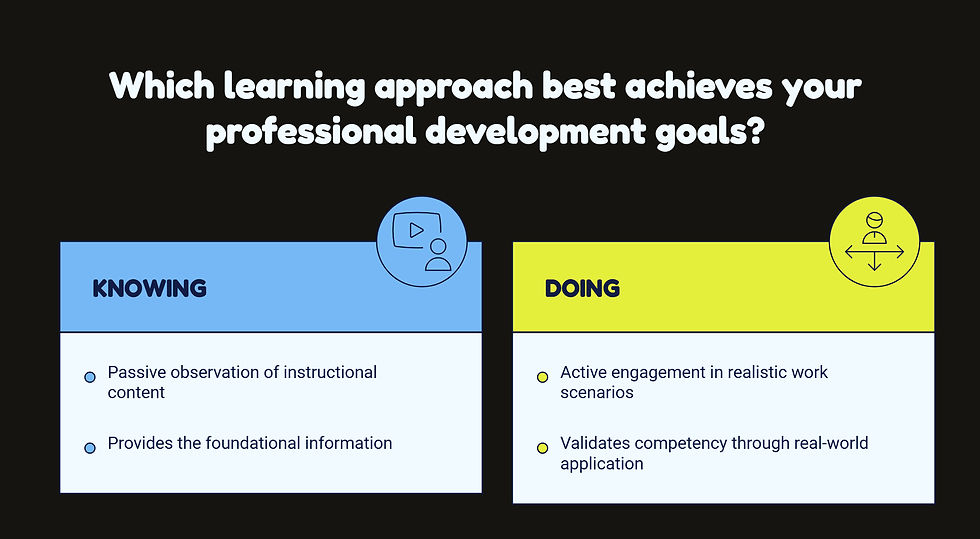
Traditional e-learning excels at delivering knowledge—facts, processes, policies, terminology efficiently and at scale. Simulation-based training excels at building and proving application—whether someone can perform under realistic conditions. The core difference is "knowing" vs. "doing": e-learning confirms exposure to information, while simulations place learners in realistic scenarios and measure the decisions they make. The two are complementary, but only simulations directly measure job readiness.

Key Insight - "Simulation training is the fastest, most effective bridge between knowing and doing."— eLearning Industry
What E-Learning Is Genuinely Good At
It's worth being fair to e-learning, because the goal isn't to replace it—it's to use it for the right job.
Traditional e-learning is efficient, scalable, and consistent. When you need to get the same foundational information to a thousand people—a new product's features, a compliance policy, a process everyone must follow—a well-made module does that faster and more reliably than anything else.
Foundational knowledge, terminology, technical theory, policy—these genuinely benefit from structured content delivery. E-learning is the right tool when the goal is "everyone needs to know this."
The problem only starts when the goal quietly shifts to "everyone needs to be able to do
this," and the format doesn't shift with it.
Where E-Learning Quietly Fails
Knowing something and being able to do it under pressure are different capabilities, built in different ways.
A video can explain how to de-escalate an angry customer perfectly. It cannot give someone the experience of staying calm while being shouted at, reading the situation in real time, and choosing the right response when several options all seem defensible.
This is the ceiling of passive learning. It transfers information effectively, but it can't build judgment—and it can't prove that judgment exists. The learner watches, absorbs, and passes, but the first time they actually apply it is live, on a real person, with real consequences.
That's an expensive place to discover a skills gap.
Visual: The Right Tool for the Job
Use E-Learning For | Use Simulations For |
Facts & Policies | Judgment Calls |
Product Knowledge | Decisions Under Pressure |
Terminology | Real Conversations |
Process Steps | Prioritization & Applied Skill |
What Simulations Do That E-Learning Can't
A simulation places the learner inside a realistic version of the actual job and lets them act—make the call, handle the objection, prioritize the competing demands, live with the consequence. Instead of watching someone else handle a situation, they handle it themselves, in a safe environment where failure is a lesson rather than a liability.
Crucially, this also makes readiness measurable. Because the learner is making real decisions, those decisions become evidence—you can see how they performed, not just whether they finished. A simulation doesn't produce a completion record; it produces a picture of capability.
As covered in "Your Training Completion Rate Is 90%. Your Readiness Rate Might Be 30%.", that shift from completion to evidence is the whole point.
"Simulation-based e-learning engages employees through realistic scenarios that build critical thinking and decision-making—and immediate feedback improves retention significantly."— UMU
So Which Should You Use?
Both—for different jobs.
The mistake isn't choosing e-learning or simulations; it's using one where the other belongs.
Deliver foundational knowledge with e-learning, because that's what it's built for.
Build and measure applied capability with simulations, because that's what e-learning fundamentally cannot do.
The practical question to ask about any piece of training is simple: Am I trying to make sure people know this, or that they can do this?
If it's "know," a well-made module is likely enough. If it's "do"—especially if getting it wrong is costly—you need practice, and practice needs a simulation.
This is the logic the Role-to-Readiness (R2R) framework is built on: start from what the role actually requires people to do, then design the simulation that proves they can.
Frequently Asked Questions
What is the difference between simulation-based training and e-learning?
Traditional e-learning delivers knowledge through content—videos, slides, quizzes—and confirms that a learner was exposed to it. Simulation-based training places learners in realistic scenarios where they make decisions and take actions, building and measuring the ability to apply knowledge. In short: e-learning teaches "knowing," simulations build "doing.
Is simulation training more effective than traditional e-learning?
For building and proving applied capability, yes—simulations let learners practice real decisions and receive immediate feedback, which improves retention and readiness. But for delivering foundational knowledge efficiently at scale, traditional e-learning is often the better tool. Effectiveness depends on the goal: knowing versus doing.
When should you use simulations instead of e-learning?
Use simulations when the goal is applied performance—judgment, decisions under pressure, difficult conversations, prioritization—especially in high-stakes roles where getting it wrong is costly. Use e-learning when the goal is transferring foundational knowledge like policies, product facts, or process steps. Many effective programs use both.
Why is "knowing" not the same as "doing" in workplace training?
Knowing is having the information; doing is applying it correctly under real conditions. Passive learning can deliver knowledge but can't guarantee someone will perform when it counts—the first real application often happens live, with real consequences. Simulations close this gap by letting people practice the doing before it matters.
Does simulation-based learning cost more than e-learning?
Simulations can require more design effort than a standard module, but they're often more cost-effective than the alternative—discovering skills gaps live, on real customers or real operations. They also reduce time-to-productivity and produce measurable evidence of readiness, which changes the return on the training investment rather than just its cost.
See it in action.
The R2R framework explainer shows exactly how a job role becomes a simulation that measures doing, not just knowing.
Curious how this applies to your roles?
R2R is how we design simulations that bridge knowing and doing — mapped to the specific roles your teams actually perform. We walk organizations through how it works. Let's talk.
[LINK: Get in touch]


Comments