

Your Candidate Interviewed Brilliantly. So Why Did the Client Call Three Months Later?

The candidate was excellent in the interview. Confident, articulate, every answer landed. The client made an offer within a day and thanked you for the find.
Three months later, the client calls. The hire is struggling with the actual work: the difficult accounts, the pricing conversations, the follow-ups that need persistence rather than charm. Now it's a replacement conversation, and your agency's name is attached to it.
Nobody did anything wrong. The interview measured what interviews measure. The problem is that the role was never about interviewing.
QUICK ANSWER
Candidates who interview well can still struggle on the job because interviews mainly show how a candidate talks about work, not how they perform in the situations the role involves. Research finds structured interviews and work samples are among the stronger predictors of job performance, while unstructured interviews predict less well (Sackett et al., 2022). For agencies, early struggles turn into replacement requests and lost client trust. A role-specific job simulation before the interview gives the client evidence of how each candidate handles real role situations, so the offer rests on observed performance as well as interview impressions.


Structured interviews (~.42) and work samples (~.33) are among the stronger predictors of job performance. Unstructured interviews predict it less well. — Sackett et al., 2022, Journal of Applied Psychology |
Interviews measure the interview
An interview is a conversation about work. It rewards people who can describe their achievements clearly, stay composed under questioning and build rapport quickly. Those are genuine strengths, and in some roles they matter a great deal.
But for customer-facing roles, the job is made of situations an interview rarely recreates: a client who pushes back on price, an escalation that needs calm and judgement, a follow-up that has gone quiet for the third time. A candidate can describe how they would handle each one and still handle it differently when it actually happens.
Part of the reason is simple human psychology. A candidate who builds rapport quickly and speaks fluently creates a strong overall impression, and that impression colours how interviewers hear everything else. A confident answer to a hypothetical question feels like evidence of competence, even when it's only evidence of preparation. None of this is the interviewer's fault; it's what conversations naturally reward.
What an early exit really costs an agency
For the client, an early exit means lost time and a role reopened. For the agency, it often means more: a replacement search done without a new fee, a client relationship under strain, and a quieter consequence that is harder to measure, which is fewer mandates next time.
Most of this cost is invisible at the moment of the offer. Everything looked right. The interview went well, the client was happy, the placement closed. The risk was sitting in the one place no one looked: how the candidate actually performs in the situations of the role.
There's an internal cost too. A failed placement takes recruiter time away from new mandates, and it shakes the team's confidence in its own process. If nobody can explain why the hire didn't work, nobody can be sure the next one will.

The warning signs an interview can't show you
Most early struggles in customer-facing roles trace back to a handful of behaviours that only appear when the work is real. They are worth naming, because they are exactly what a good simulation is designed to surface.
1. How the candidate responds when a client says no, or pushes back on price.
2. Whether they follow up a third time when a deal has gone quiet, or quietly move on.
3. How they prioritise when several urgent things land at once.
4. What they do when a client asks for something outside policy.
5. Whether they escalate too early, too late, or at the right moment.
None of these is easy to judge from a conversation. All of them can be observed when a candidate works through realistic situations from the role. When you can see them before the offer, the three-month phone call becomes far less likely to surprise anyone.
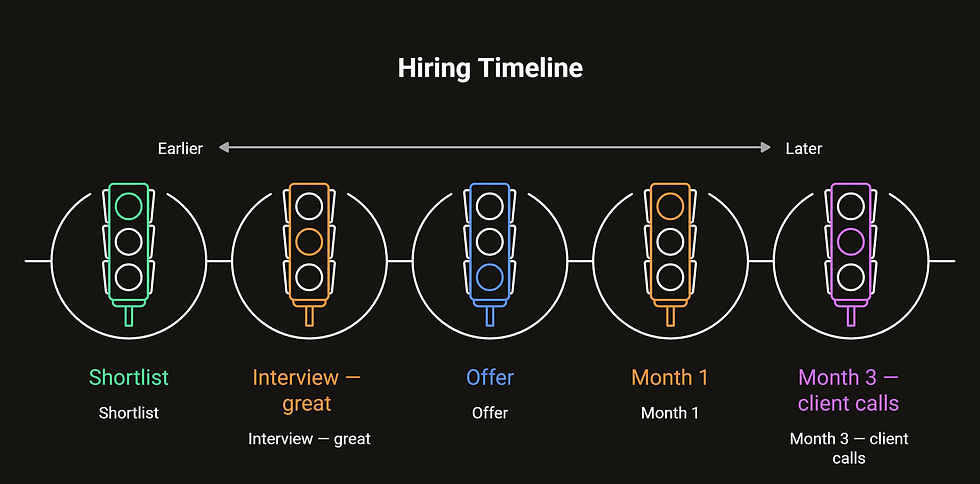
Move the evidence before the offer
The fix isn't to interview harder. It's to add a different kind of evidence earlier. Before the client interviews, put each shortlisted candidate through realistic, role-specific situations built from the job description, and capture how they handle them.
Then the interview has something to work with. Instead of “tell me about a time you handled a difficult client”, the client can ask “in the simulation you offered a discount straight away; walk me through why.” Strong interviewers who also perform well stand out. Strong interviewers who don't are visible before the offer, not three months after it.
A brilliant interview is a good sign, not a guarantee. The agencies that protect their reputation are the ones that check the work before the offer, not the ones that interview harder.
HireQuo by QuoDeck gives agencies that evidence on every mandate. A custom simulation is built from the client's job description within 24 hours, and each candidate who completes it comes with a detailed Fitment Report you can share with the client. It works alongside interviews, never instead of them. If you're hiring for sales roles, Your Best Interviewer Will Probably Hire Your Worst Salesperson explains the same pattern from the employer's side.
Frequently asked questions
Why do new hires fail even after strong interviews?
Because interviews mainly measure how candidates talk about their work. For customer-facing roles, performance depends on how people handle recurring situations such as price objections and escalations, which interviews rarely recreate.
Do interviews predict job performance?
Some do better than others. Research by Sackett et al. (2022) found structured interviews (~.42) and work samples (~.33) are among the stronger predictors of job performance, while unstructured interviews predict it less well.
How can recruitment agencies reduce early attrition?
By adding evidence of on-the-job performance before the offer. A role-specific job simulation shows how each candidate handles realistic situations, so clients can make offers based on observed performance as well as interview impressions.
Why does an early exit hurt an agency more than the client?
Because the agency often absorbs the replacement work and the reputational cost. A client who has seen one placement fail is more cautious about the agency's next shortlist.
Does a job simulation replace the interview?
No. It works alongside the interview, giving the hiring team evidence to probe so the interview becomes more useful rather than redundant.
Curious how this works on your next mandate?
HireQuo builds a role-specific job simulation from your client's job description, so every candidate you shortlist comes with evidence, not just experience on paper. Try HireQuo for free on your next role.


Comments