

80% of Companies Offer Upskilling. 70% of Employees Still Feel Unprepared.

There's a number most L&D leaders would be proud of: the vast majority of companies now offer upskilling.
Budgets are up, catalogues are enormous, platforms are everywhere. On paper, the skilling problem is being solved.
Then you ask the employees. And roughly seven in ten of them say they still feel unprepared for what's coming at work.
Same companies. Same programs. Opposite conclusion.
That gap offered a lot of training, still can't do the job is the real skilling problem.
And it isn't a budget problem or an effort problem.
It's a design problem: most skilling is built to be consumed, not practised.
Employees finish the content and still can't perform, because watching, reading, and passing a quiz were never going to build a skill on their own.
Quick Answer
Most upskilling and reskilling programs fail not because companies don't invest, but because they're designed around content delivery rather than practice.
Employees consume material videos, modules, quizzes and are then expected to perform without ever having rehearsed the actual skill.
Two structural flaws make it worse:
Skilling usually starts too late after the mistake has already happened.
Skilling is too broad everyone gets the same content regardless of their actual gap.
The fix is to treat skilling as diagnosed, practised, and measured capability the basis of the R2R Skill approach. the approch is that most of the people
Hero Visual: More Training. Same Gap.
Visual concept: Two large figures.
Left: A company figure surrounded by training icons videos, modules, certificates labeled "80% OFFER UPSKILLING."
Right: An employee figure looking uncertain at a looming challenge, labeled "70% STILL FEEL UNPREPARED."
Caption: More training. Same gap.

"80% of employers say they offer upskilling but 70% of workers report feeling unprepared for the future of work." Correlation One
The Problem Isn't How Much Training. It's What Training Is Built to Do.
Almost every skilling program follows the same quiet logic:
Here's the product. Here's the process. Here's the policy. Here's the video. Here's the quiz. Here's the certificate.
And then everyone waits for performance to improve.
The activity is real. The consumption is measurable.
But consumption and capability are different things, and the program only ever measures the first.
It's the difference between handing someone a swimming manual and being surprised they're still drowning.
The manual is genuine information. It just isn't the thing that keeps you afloat.
Knowing what good looks like and being able to do it under real conditions are separate achievements, built in separate ways — and most skilling stops at the first one.
"Only 12% of employees report applying the skills they learn through typical corporate training to their actual jobs."— 24x7 Learning, via OneRange
Two Structural Flaws in How Companies Build Skills
Flaw One: Skilling Starts Too Late
By the time training gets assigned, the thing it was meant to prevent has usually already happened.
The customer has already complained.
The sales opportunity has already been lost.
The process has already been bypassed.
Then a manager says, "we need to do something," and that something is a workshop often with a title like "Driving Excellence Through a Customer-Centric Mindset," which roughly translates to "several things went wrong and we're not naming them directly."
Skilling built this way is permanently reactive.
It arrives after the cost has been paid, aimed at a mistake that's already in the past.
Practice, by contrast, can happen before the stakes are real which is the entire point of a simulation.
Flaw Two: Skilling Is Too Broad
The second flaw is that everyone gets the same content.
The strong performer, the struggling one, the brand-new joiner, the ten-year veteran, the person with a genuine judgement gap all assigned the identical module, because identical is scalable.
But scalable wrongness is still wrongness.
A program that's equally irrelevant to everyone is efficient only in the sense that it wastes everyone's time at the same rate.
Real capability-building starts from a different question.
Not "What content should we assign?" but "What specifically needs to improve, for this person, right now?"
That's a diagnosis, not a catalogue.
And it's where skilling stops being a broadcast and starts being development.
As explored in The New Hire and the Ten-Year Veteran Are in the Same Training. That's the Problem., one-size-fits-all is the single most common reason skilling budgets underperform.
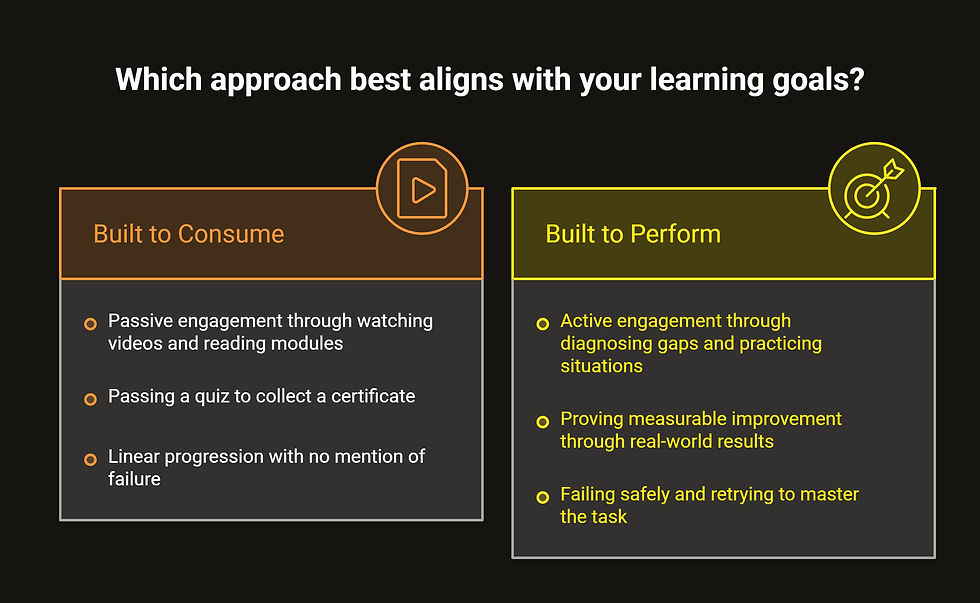
Content vs. Capability: Two Ways to Build a Skill
Built to Consume
Watch the video
Read the module
Pass the quiz
Collect the certificate
Built to Perform
Diagnose the real gap
Practise the actual situation
Fail safely and retry
Prove measurable improvement
What Skilling That Actually Works Looks Like
Skilling that changes performance shares a shape, and it isn't more content.
It starts by diagnosing the specific gap:
Can this person handle the situation today, and where exactly do they struggle?
Then it gives them a safe place to practise that exact situation, fail without real-world damage, and try again.
Then it measures whether they're genuinely better than before not whether they finished, but whether they improved.
This is the shift from measuring activity to measuring capability.
It's the promise of the R2R Skill approach:
Start from the real performance gap.
Build a simulation that lets people practise the actual behaviour that needs to improve.
Produce evidence of development rather than a record of completion.
The report stops saying:
"Employee completed the module."
And starts saying:
"Employee was weak in escalation judgement, practised three scenarios, improved decision quality, and is now ready for supervised customer handling."
That's a fundamentally different way of thinking about skilling.
Frequently Asked Questions
Why do most upskilling and reskilling programs fail?
Because they're designed around content delivery rather than practice.
Employees consume training material and are then expected to perform without having rehearsed the skill.
Compounding this, programs often start too late — after a mistake has already occurred — and are too broad, assigning everyone the same content regardless of their actual gap.
Why do employees feel unprepared even when companies offer lots of training?
Because offering training and building capability are different things.
Most programs measure consumption — courses completed, modules watched — rather than whether employees can actually apply what they learned.
Research shows only a small percentage of training transfers to on-the-job performance, which is why employees can be heavily trained yet still feel unprepared.
What does it mean that skilling "starts too late"?
It means training is typically assigned reactively — after a customer has complained, a deal has been lost, or a process has been bypassed.
The skilling arrives after the cost has already been paid.
Practice-based approaches like simulations can build capability before the stakes are real, rather than responding after failure.
Why is one-size-fits-all training ineffective?
Because employees have different gaps.
A strong performer, a struggling one, and a brand-new joiner need different things, but a generic module gives them all the same content.
This makes the training equally irrelevant to most of them.
"Scalable wrongness is still wrongness."
And ultimately, it wastes both time and budget.
How is a skilling simulation different from an e-learning course?
An e-learning course delivers content and confirms consumption.
A skilling simulation diagnoses a specific gap, lets the employee practise the actual situation and fail safely, and measures whether their capability genuinely improved.
The measurement therefore shifts from:
Activity completed → Capability built
The R2R Select explainer breaks down why interviews reward interviewing—and how hiring simulations show what candidates can actually do.
Curious how this applies to your roles?
R2R Select is how we design hiring simulations that produce real evidence of candidate readiness—mapped to the specific roles you're hiring for. We walk organizations through how it works.


Comments